
We Are Algae, Rendered at Maximum Resolution
Human life shares its chemistry and evolutionary history with the rest of the living world. That continuity gives me reasons for a naturalistic view, while leaving the origins of life and the conditions for consciousness open to investigation.
A falling object responds to gravity, with its motion also affected by air resistance and the conditions under which it was released. Changing those conditions changes what we should expect. The value of a physical explanation is that someone else can examine the conditions, test the prediction and find where the account fails. Our confidence or disappointment cannot substitute for that test.
I start from this ordinary dependence on evidence when thinking about humanity's place in nature. Physical explanations have to account for what happens, including events we would prefer to have happened differently. Calling an event good or bad can affect how we respond to it, while leaving the causes to be investigated. Human beings make those judgements as organisms within the world they are examining.
Energy moving through matter can produce organised patterns. Heating a fluid under suitable conditions can generate convection, and vibrations can arrange particles on a plate into patterns associated with its motion. Such examples show that organisation can arise through physical processes. Moving from these patterns to a living organism requires much more to be explained: a convection pattern does not by itself establish a route to heredity, metabolism or cellular reproduction.
Stanley Miller's 1953 experiment showed that an electrical discharge through a particular mixture of gases and water could produce amino acids. It provided an experimental route to some organic compounds important to life under the conditions tested. The apparatus did not produce an organism, and its gas mixture does not settle which conditions operated on the early Earth. Later work on possible prebiotic chemistry investigates parts of the problem. The history that connected such processes to the first evolving living systems remains incomplete.
A green layer appearing in an exposed pool answers a different question. Existing organisms can arrive and grow when conditions permit them. Even if the water was initially sterilised, exposing it to the environment allows living material to enter. Watching a pool become green therefore shows colonisation and growth, rather than the emergence of life from nonliving chemistry. Water, nutrients and energy can support organisms without guaranteeing that life will originate wherever those conditions occur.
Once there are reproducing populations with heritable variation, evolution provides an account of how their characteristics can change. In a laboratory study, researchers observed E. coli spreading across a plate containing increasing concentrations of antibiotics and evolving resistance. Resistant lineages could grow into areas that others could not reach. The experiment made changes under selection visible, without requiring the bacteria to anticipate the conditions ahead of them. How adaptation proceeds depends on the organisms, the available variation and the environment.
Our mitochondria produce much of the ATP our cells use to supply energy for their activities. These structures descend from bacterial ancestors, preserving evidence of an evolutionary history in which formerly separate organisms became interdependent. The genetic code is also shared remarkably widely across living things, with some variations. These features locate us within a history we share with other organisms, extending far beyond the appearance of humans.
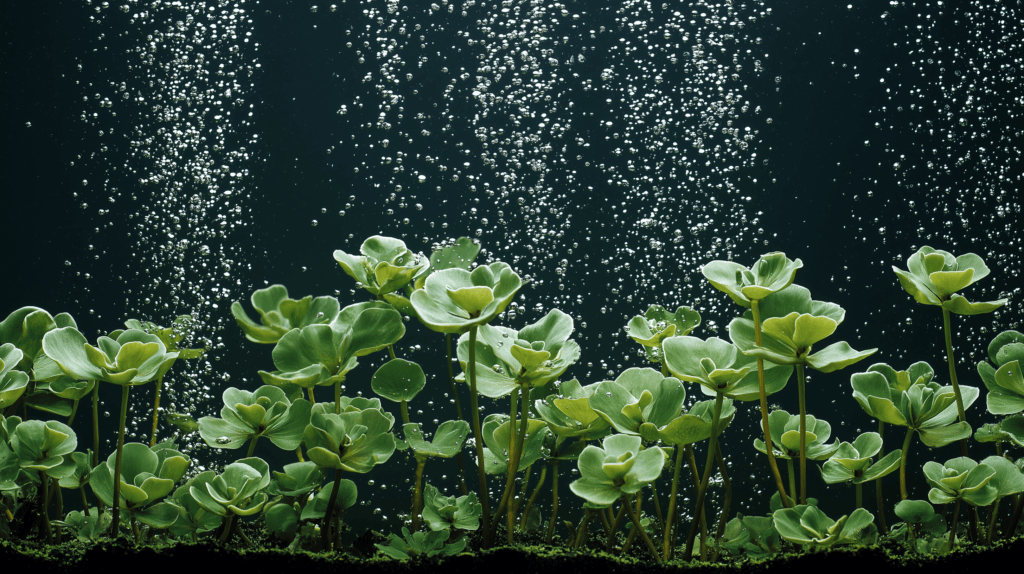
I use the image of algae at maximum resolution to draw attention to this continuity. It is a metaphor, and an imperfect one if it suggests a single ladder with humans at the top. Algae comprise varied forms of life with their own evolutionary histories; human beings are not their finished version. We share inherited biological processes while differing in particular structures and capacities. A greater capacity for one kind of information processing supplies no universal measure by which an organism is more complete.
General anaesthesia can make a person unconscious by altering activity in the nervous system. That relationship gives us substantial reason to investigate experience through brain function. It does not yet tell us which physical features are sufficient for consciousness, or how subjective experience arises. A description of a system as highly integrated or complex leaves those questions to be answered. Information processing covers processes much more broadly than consciousness, so identifying it cannot by itself establish that something has felt experience.
My own view is that human experience belongs within the natural history that produced the organisms capable of it. Shared cellular mechanisms, evolutionary relationships and dependence on brain function give that view support. They do not turn the entire sequence from chemistry to consciousness into a deductive proof. The gaps are real research problems, and an account of how life began is a different achievement from evidence that species change once life exists.
Seeing humanity in this way leaves our capacities substantial and our position less exceptional. We can investigate processes that produced us, assess some of the consequences of our actions and change the conditions in which we live. Biological continuity does not decide which purposes deserve those abilities. The same organism can investigate how life began and spend an evening scrolling past things it barely wants to see.
Further reading: Stanley L. Miller (1953), A Production of Amino Acids Under Possible Primitive Earth Conditions; Baym et al. (2016), Spatiotemporal microbial evolution on antibiotic landscapes; Shih and Matzke (2013), Research on mitochondrial and plastid endosymbiosis; MRC Laboratory of Molecular Biology, Syn57 represents a new chapter in the genetic code of life; National Institute of General Medical Sciences, Anesthesia; Cogitate Consortium et al. (2025), Adversarial testing of global neuronal workspace and integrated information theories of consciousness.