Past experience can offer a starting point for understanding what's happening now. These questions concern using remembered situations and familiar ways of doing things over the past three to twelve months, while checking what's different now.
Lower endorsementHigher endorsement
One possible momentLooking closely at the object, with or without earlier notes to compare.
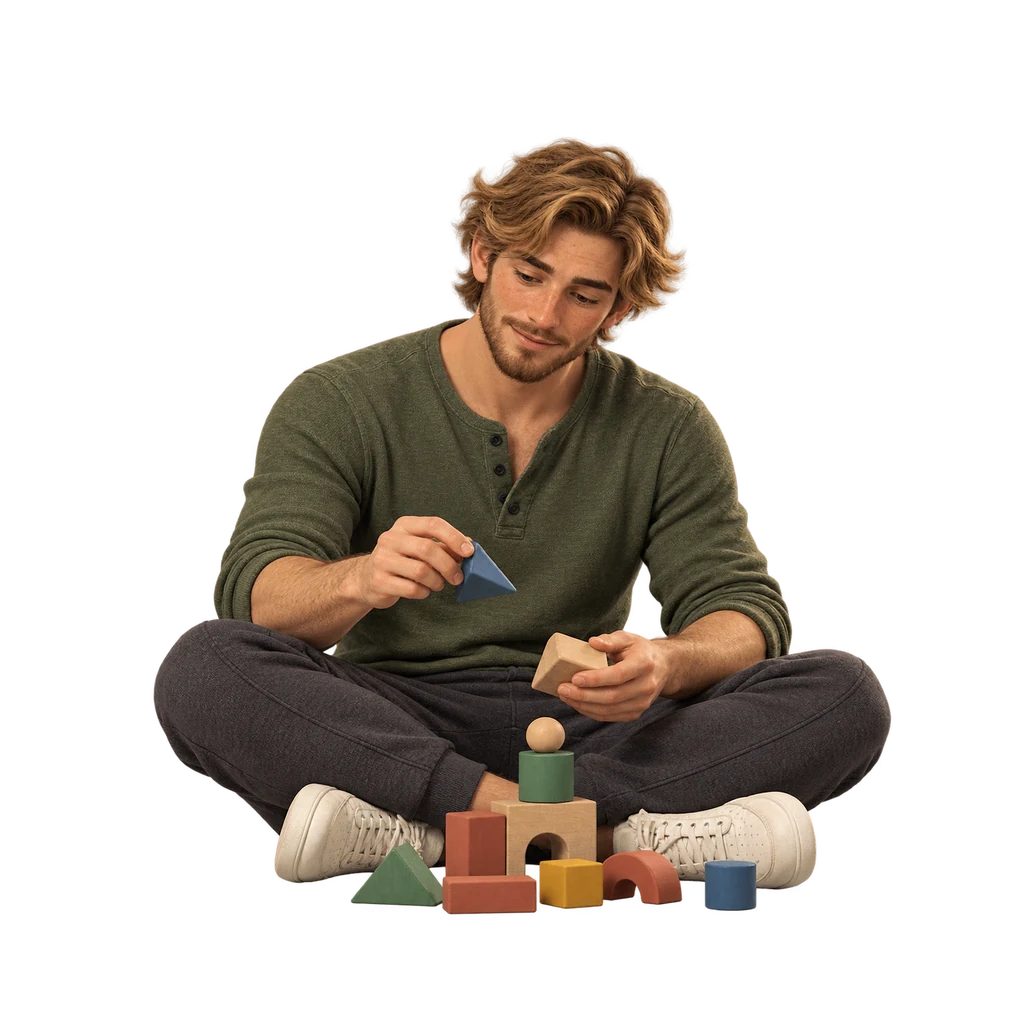
Fictional characters illustrate possible approaches. Appearance does not determine personality.
What this can look like
You start with a familiar recipe, then notice that today's ingredients or equipment call for a few changes.
Keep in mind
These questions need proper research testing. Answers can't establish memory accuracy, identify a personality type or reveal a fixed order of thinking approaches.
For adults exploring their own experience. These guides cannot diagnose a condition, measure your worth or decide who is suitable for a job or relationship.
Choose how to explore
Use the pictures or read the detail. Your result does not decide how you should learn.
Compare the present with a particular memory, including what has changed.
How this can look
See it from another angle
+
Use a specific earlier event
Recall what happened during a relevant previous attempt. A concrete precedent is more informative than a general feeling that things always go this way.
You are arranging tables for a community workshop in a room used last summer. You remember glare making one corner difficult, but this session will be on a winter evening with different lighting.
What it offers
Referring to the earlier workshop supplies a specific practical issue to inspect before people arrive. The memory gives the setup a useful starting point and preserves a lesson that might otherwise be lost between events.
A question to keep
Which part of the summer experience still matters under the evening lighting?
These situations are examples to think about. They do not predict what you will do. The diagram connects ideas in the guide; it does not measure your mind or show scores.
6 minute read · Read in order or choose a section
The situations in this guide are invitations to compare with your own experience. They are not measured predictions about you.
On this page 11 sections
What it means
This is a proposed approach of referring to specific remembered experiences and familiar procedures when understanding the present. A remembered comparison needs checking because the current conditions may differ.
These four direct-endorsement questions concern your usual approach over the past three to twelve months. The eight candidate approaches can coexist; they do not supply a fixed function order or a four-letter type.
Lower on this response scale
Less reported reference to familiar experience; this does not imply poor memory.
Higher on this response scale
More reported reference to familiar experience; this does not establish memory accuracy or resistance to change.
These are ends of a spectrum, not two kinds of person. Context and the middle of the scale matter too; neither end measures your worth.
In everyday life
A familiar sound reminds you how you handled a similar household issue last time.
You use a known recipe as a starting point and note what is different today.
Strengths and blind spots
What this approach can offer
A concrete previous example can provide a useful starting point.
A familiar procedure can reduce the effort of an ordinary repeated task.
What can be easy to miss
A remembered match can hide a detail that makes this situation different.
Familiarity can feel like evidence that a procedure is still suitable.
These are possibilities to check against your experience, not predictions about everyone with a similar result.
Using a particular earlier experience
Referring to experience concerns understanding the present through specific remembered events and familiar procedures. The four candidate questions ask whether you compare a new situation with a particular memory, notice a change in a familiar routine, use details from earlier attempts and recall how a task went last time before beginning it again. These activities concern the use of memory, not a test of how accurately you remember.
A possible experience is recognising a small practical detail because it mattered before. When preparing a shared room, you recall that afternoon light made one corner difficult to use and suggest another position for the tables. The remembered comparison gives the current decision a useful starting point. Its relevance still depends on whether the season, activity and room arrangement are similar enough.
More reported use suggests that specific precedents and familiar procedures often inform your approach. It does not establish memory accuracy, conscientiousness, conservatism or resistance to change. A remembered failure can motivate a new method just as readily as a remembered success can support repeating an old one.
Less reported use does not imply poor memory or disregard for experience. You may rely on written records, general principles, current observation or a procedure whose origins you no longer consciously recall. You may also be working in a setting with few relevant precedents. The possible cost is repeating an avoidable difficulty because the earlier lesson was not brought into the current choice.
At either endpoint, ask how the past is being used. A particular memory can be valuable evidence, while remaining one case whose conditions and accuracy deserve examination.
Suppose you once struggled to organise transport for a group outing and now expect another outing to be difficult. The earlier experience may contain important details: late confirmations, limited seats or an unsuitable pickup point. It does not establish that every group outing will reproduce the same problem.
Nousophy asks you to identify the support for the present expectation. Which conditions recur? Which have changed? A memory of the overall frustration may be vivid while the details needed for comparison remain unclear. Check messages, notes or another participant's account where appropriate, recognising that these sources can also be incomplete.
A useful lesson is specific enough to guide action: confirming numbers earlier would address the previous shortage of seats. A global lesson such as group plans never work may preserve the emotional force of the event while discarding its most useful information.
A routine can store knowledge without becoming sacred
Familiar procedures can reduce repeated effort and protect against mistakes. They may embody knowledge gained through many attempts, even when no one remembers every reason for each step. Before changing one, ask what it accomplishes. Before retaining it, ask whether the conditions that made it useful still apply.
Imagine following a familiar order when preparing a small stall. If the venue changes, the same order may leave equipment inaccessible or create unnecessary lifting. Revisiting the earlier sequence can help you adapt intelligently rather than choosing between rigid repetition and starting from nothing.
A change standing out to you does not mean you oppose it. Noticing the difference can be the first step in evaluating it. State what changed and what consequence you anticipate, then check the prediction. This turns familiarity into an accountable source of information rather than a reason that ends discussion.
The earlier event does not speak for the person now
In relationships, remembered experiences can support trust, caution or a request for clearer agreements. A pattern of missed commitments deserves attention. Yet a present interaction still needs to be described on its own terms. The person, circumstances and agreement may differ from the event that first comes to mind.
If a friend's delayed reply reminds you of an earlier disappointment, separate the two records. What happened then? What is known now? What question needs answering before you infer the same meaning? This does not require ignoring repeated conduct or abandoning reasonable boundaries. It keeps the boundary connected to evidence rather than to resemblance alone.
Under pressure, caution and extensive task experience may make precedent especially salient. Fatigue or incomplete information may also affect what you recall. None establishes that the preference conceals a defence. Investigate the actual conditions and the practical value of the comparison.
This approach can coexist with generating alternatives, forming an overall interpretation, engaging with present details and organising an outcome. It does not occupy a fixed position in a cognitive-function stack or establish a four-letter type. Nor does it measure general traditionalism: a person may draw on specific experience while enthusiastically changing a custom.
The scale contains four original, positively worded, unvalidated Nousophy candidate items. Their coverage is limited and responses may be affected by a general tendency to agree. They concern self-reported reference to experience, not performance on a memory task. Compare familiar and unfamiliar settings, and include cases where a record corrected your recollection. Correction improves the usefulness of experience rather than cancelling its value.
Choose a safe recurring task, such as preparing materials for a hobby session. Before beginning, write what you remember from the previous attempt: one helpful choice, one difficulty and the conditions that mattered. Mark any detail you are unsure about. Check a relevant record if one exists, without treating memory or documentation as automatically infallible.
Identify what is different this time and make one proportionate adjustment. After the task, compare the outcome with your expectation. Did the earlier experience transfer? Did a changed condition make the comparison misleading? Record a narrow lesson that could guide the next attempt.
The aim is neither to repeat the past faithfully nor to escape it. It is to use remembered experience as revisable evidence, retaining what remains informative and changing what the current situation requires.
All four original candidate items need numeric answers before the 1–5 equal-weight mean appears. All four are direct endorsements. The minimum coverage rule, thinking-approach labels and illustrative examples do not establish reliability or validity. The source for the exact construct is the current Nousophy registry, not a validated Jungian-function test.
This construct does not establish: memory accuracy, conservatism, conscientiousness or resistance to change.
These are original, unvalidated candidate items; four positively worded questions provide limited coverage and can be affected by a general tendency to agree.
No cognitive-function stack, personality type or relationship with another framework can be inferred from this score.
Context to consider: Extensive experience with the task. Caution under uncertainty.
Use this guide for adult self-reflection. It is not a diagnosis or a basis for recruitment, relationship decisions or other consequential judgements.