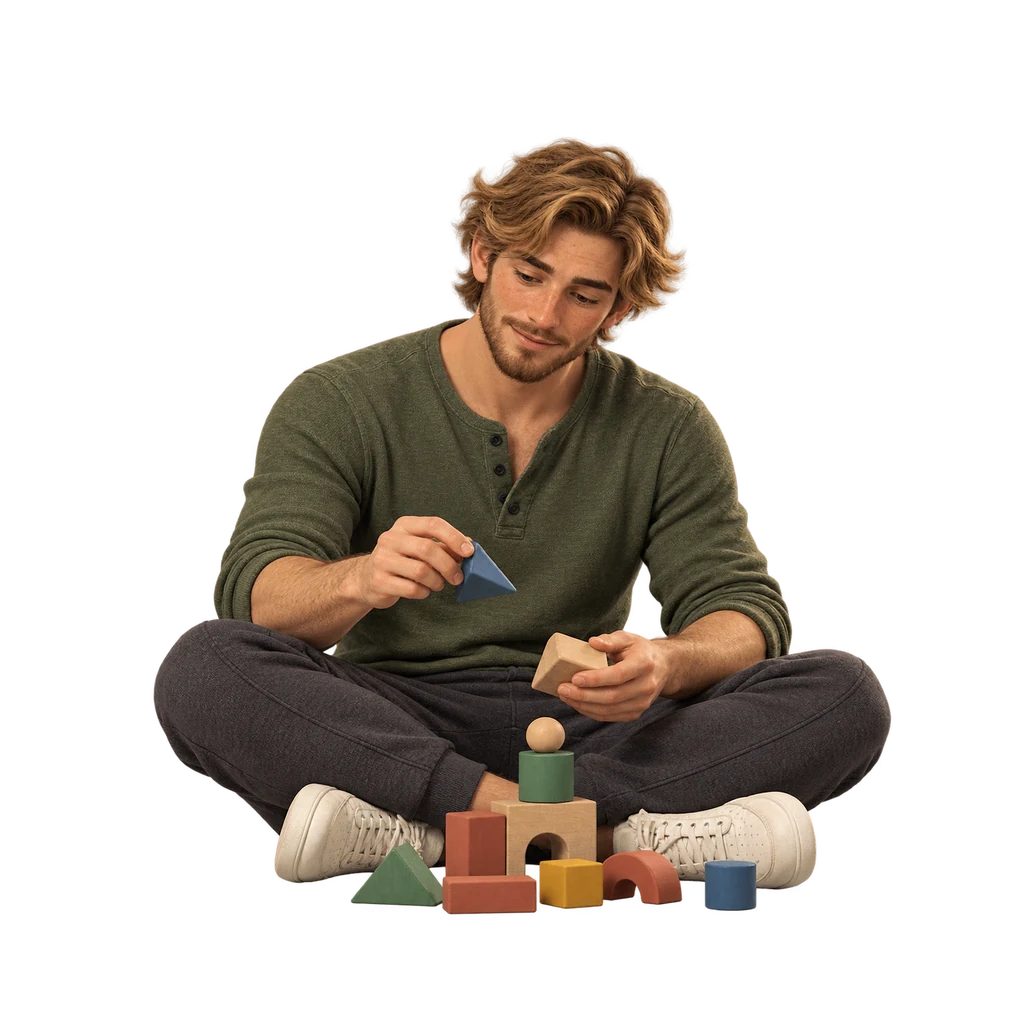
This approach involves paying attention to what's happening in front of you and responding as conditions change. The questions ask about your reported use of current, concrete information over the past three to twelve months.
Lower endorsementHigher endorsement
One possible momentShall I think it through first, or try moving a part?
Fictional characters illustrate possible approaches. Appearance does not determine personality.
What this can look like
While carrying a box, you notice its weight shift and adjust your grip to suit what's happening now.
Keep in mind
These questions need proper research testing. Answers can't establish physical skill or risk-taking, identify a personality type or reveal a fixed order of thinking approaches.
For adults exploring their own experience. These guides cannot diagnose a condition, measure your worth or decide who is suitable for a job or relationship.
Choose how to explore
Use the pictures or read the detail. Your result does not decide how you should learn.
Use safe present information to answer a limited practical question.
How this can look
See it from another angle
+
Look at the current conditions
Attend to what is visible or otherwise accessible now. Avoid replacing today’s details with an expectation about how the setup normally works.
While setting up a shared reading table, you notice a lamp reflecting off the tabletop. Moving it a short distance clears your view, but another participant will sit on the opposite side.
What it offers
Attending to the actual reflection makes the problem concrete. A small reversible adjustment lets you compare the visible result immediately, rather than relying only on a description of where the light ought to fall across the table.
A question to keep
What would you need to inspect before calling the lamp position suitable for the shared table?
These situations are examples to think about. They do not predict what you will do. The diagram connects ideas in the guide; it does not measure your mind or show scores.
6 minute read · Read in order or choose a section
The situations in this guide are invitations to compare with your own experience. They are not measured predictions about you.
On this page 11 sections
What it means
This is a proposed approach of attending to current concrete information and engaging directly as conditions change. It describes a reported way of attending, not athletic skill or a willingness to take risks.
These four direct-endorsement questions concern your usual approach over the past three to twelve months. The eight candidate approaches can coexist; they do not supply a fixed function order or a four-letter type.
Lower on this response scale
Less reported direct engagement with changing conditions; this does not imply poor perception.
Higher on this response scale
More reported direct engagement; this does not establish sensory acuity, impulsivity or athletic ability.
These are ends of a spectrum, not two kinds of person. Context and the middle of the scale matter too; neither end measures your worth.
In everyday life
You adjust how you carry a box after noticing its weight shift.
When a cooking step behaves differently than expected, you respond to what is in front of you.
Strengths and blind spots
What this approach can offer
Direct attention can reveal a detail a prior plan missed.
Responding to current conditions can make an immediate adjustment possible.
What can be easy to miss
The most noticeable present detail can crowd out relevant background information.
Immediate engagement can leave too little time to consider a less visible consequence.
These are possibilities to check against your experience, not predictions about everyone with a similar result.
Learning from what is happening now
Engaging with the present concerns taking in current concrete information and responding directly as conditions change. The four candidate questions cover noticing surrounding details during an activity, getting a feel for an unfamiliar object by handling it, preferring activities with changing conditions and trying an adjustment to see what happens. These activities are related but not identical, and the handling example will not fit everyone's physical or sensory access.
A possible experience is that a practical question becomes clearer through safe contact with the actual situation. Moving a lamp reveals a reflection that was difficult to anticipate from a description. The adjustment supplies information immediately. It does not establish that direct exploration is sufficient for every question, particularly where a hazard or a delayed effect cannot be recognised in the moment.
Engagement is not a measure of perception or courage
More reported use suggests that present details and direct adjustment feature often in your approach. It does not establish sensory acuity, athletic ability, risk taking or impulsivity. A carefully bounded practical trial can be cautious, and a person may engage directly while respecting extensive preparation and safety requirements.
Less reported use does not imply poor perception or inability to act. You may prefer instructions, a demonstration, a model or time to understand the task before touching anything. Access needs, unfamiliarity, fatigue and the environment may also affect which examples are available or comfortable. The possible cost is remaining with an abstract account after a safe observation could answer the question more clearly.
The useful distinction is between the approach you report and the quality of its use. Both direct exploration and advance preparation can be careful or inadequate depending on the situation.
Nousophy distinguishes observed consequences from the explanation you give them. If moving a chair makes a space easier to cross, you have evidence about that arrangement under the conditions you tried. You have not necessarily shown that it suits everyone, remains workable when the room is full or meets relevant access requirements.
State what changed, what happened and what remains unknown. Where practical, alter one feature at a time so that the result is easier to interpret. If several things change together, acknowledge that you may not know which mattered. A useful outcome can justify retaining a reversible arrangement while leaving its explanation uncertain.
Some questions cannot be safely answered by trying. Electrical work, unfamiliar machinery and other hazards require appropriate knowledge and procedures. A preference for learning through action is not permission to bypass them. Direct engagement should be bounded by the consequences of error.
Concrete attention can reveal information that a plan missed: an awkward reach, a distracting sound or a route people actually use. In a shared space, these observations can improve the arrangement. They remain observations from a particular position and body. Another person may encounter a different obstacle or benefit from a feature you find unnecessary.
Imagine adjusting the layout of a craft table. You may find tools easier to reach after moving them, while someone else loses needed space or can no longer identify where items belong. Ask before making shared changes and check the effect with those involved. Your own improvement is relevant evidence without being the entire measure of success.
The same principle applies to conversation. A visible reaction may prompt an immediate response, but its meaning still needs interpretation. Being present to an event does not make every inference about it accurate.
Practical training can make direct engagement more useful because you learn which details matter and which adjustments are appropriate. An environment that demands immediate response can also increase the reported use of this approach. Neither condition proves an enduring style or guarantees expertise. Examine the feedback available: can you recognise a good result, detect an error and learn what caused it?
When practising a safe manual or creative task, a demonstration followed by a small attempt may be informative. Compare the outcome with a clear criterion and ask for correction where needed. Repetition without feedback can make an unhelpful method familiar.
Under pressure, immediate action may prevent a problem from growing or may create an avoidable second problem. Separate what must happen now from what can wait for a check. The urgency of acting changes the time available; it does not increase the certainty of your explanation.
This approach can accompany remembered experience, broad interpretation, possibility generation and explicit planning. It supplies no fixed cognitive-function order and cannot determine a four-letter type. Attention to present detail also differs from a general preference for excitement: a quiet, careful adjustment can fit the construct, while a thrill-seeking activity may tell you little about it.
The scale uses four original, positively worded, unvalidated Nousophy candidate questions with limited coverage. General agreement tendencies may influence responses. Physical and sensory access, practical experience and current demands need to be considered when interpreting the items. A lower endorsement of handling an unfamiliar object cannot be used as evidence of a deficient capacity when that activity is inaccessible or inappropriate for you.
Choose a harmless, reversible task you already control, such as positioning a reading light or arranging materials for an activity. Use an accessible form of direct observation; handling an object is optional. State what you expect one adjustment to improve and identify anything it must not worsen.
Try the change under ordinary conditions and compare the actual result with the prediction. If other people are affected, get their agreement and observations. Keep a brief record so that the immediate impression can be revisited later. Did the benefit persist? Was there a consequence that only appeared after use?
The exercise connects contact with reflection. You are learning from what happens while keeping the scope of the conclusion proportionate. The result may support retaining the change, reversing it or gathering information that direct experience alone could not supply.
All four original candidate items need numeric answers before the 1–5 equal-weight mean appears. All four are direct endorsements. The minimum coverage rule, thinking-approach labels and illustrative examples do not establish reliability or validity. The source for the exact construct is the current Nousophy registry, not a validated Jungian-function test.
This construct does not establish: athletic ability, risk taking, impulsivity or sensory acuity.
These are original, unvalidated candidate items; four positively worded questions provide limited coverage and can be affected by a general tendency to agree.
No cognitive-function stack, personality type or relationship with another framework can be inferred from this score.
Context to consider: Practical training. An environment that demands immediate response.
Use this guide for adult self-reflection. It is not a diagnosis or a basis for recruitment, relationship decisions or other consequential judgements.