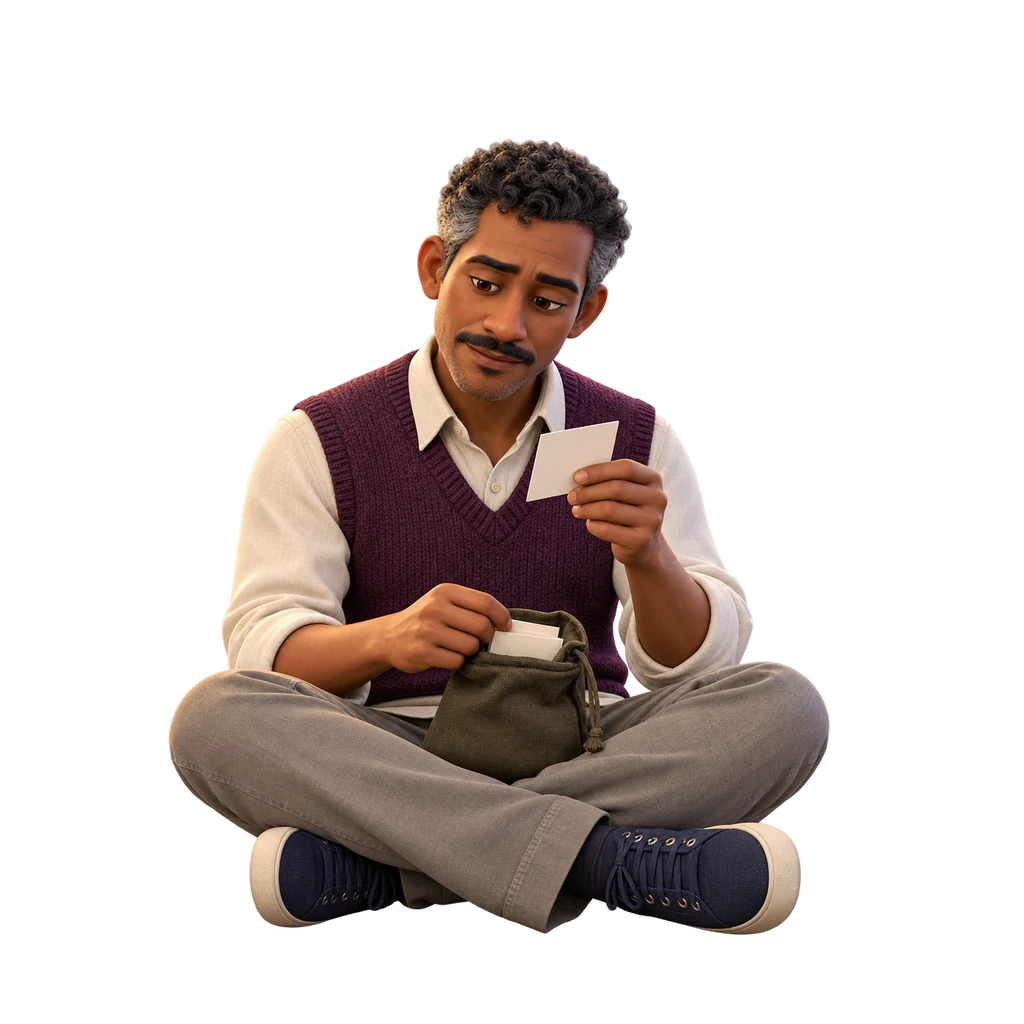
Difficulty resisting urges concerns reports of temptation, cravings, binges or going beyond an intended amount. The questions leave the activity open, so people may answer with quite different experiences in mind.
Lower endorsementHigher endorsement
One possible momentPutting the phone down, or finding yourself checking it once more.
Fictional characters illustrate possible approaches. Appearance does not determine personality.
What this can look like
You planned to stop after one episode, but another begins and you find yourself watching beyond the time you intended.
Keep in mind
These answers cannot establish addiction or control across every part of life; one kind of urge may differ from another.
These averages describe your answers. They do not rank you against other people, and research on the original questions does not confirm how well this particular report works.
For adults exploring their own experience. These guides cannot diagnose a condition, measure your worth or decide who is suitable for a job or relationship.
Choose how to explore
Use the pictures or read the detail. Your result does not decide how you should learn.
Compare the chosen amount with what happened after the urge appeared.
A range of responses
Explore both ends
↔
Less stopping difficulty
Resisting one urge readily does not establish control in every area of life.
Someone plans to watch one episode before going to bed, but another begins automatically. They enjoy the programme and now face a choice between continuing and the earlier intention, with tomorrow’s plans still unchanged.
Less stopping difficulty
Someone reporting less difficulty resisting urges might stop when the next episode begins and return to the earlier plan. That event would describe one successful stopping point, not demonstrate superior character or control across shopping, eating and every other tempting situation.
A question to keep
Was the longer viewing a chosen revision or a departure from an intention that still mattered?
These situations are examples to think about. They do not predict what you will do. The diagram connects ideas in the guide; it does not measure your mind or show scores.
6 minute read · Read in order or choose a section
The situations in this guide are invitations to compare with your own experience. They are not measured predictions about you.
On this page 11 sections
What it means
This facet concerns difficulty resisting urges or going beyond an intended amount. An urge, an action and its consequences are separate; these items cannot determine an addiction or a general lack of self-control.
Read lower and higher as directions within your response average, not population rankings or good and bad categories. Different situations and narrower facets can complicate a broad summary.
Lower on this response scale
Less reported difficulty resisting the urges described; this is not proof of control across all situations.
Higher on this response scale
More reported difficulty resisting those urges; this does not establish addiction or moral failure.
These are ends of a spectrum, not two kinds of person. Context and the middle of the scale matter too; neither end measures your worth.
In everyday life
You continue browsing after deciding to put your phone down.
You take another portion even though you had intended to stop.
Strengths and blind spots
What this approach can offer
Recognising a repeated urge can help you plan a practical pause in that particular setting.
Finding some urges easier to resist can support a chosen limit.
What can be easy to miss
A strong immediate pull can overshadow a limit you chose earlier.
An easy experience in one setting can lead you to underestimate a difficult urge in another.
These are possibilities to check against your experience, not predictions about everyone with a similar result.
The gap between an urge and an intention
You decide to stop watching after one episode, then notice that another has begun. The immediate appeal is clear; the earlier intention has become less available. This is one ordinary illustration of difficulty resisting an urge, but the source items are broader and do not specify a single behaviour. They ask about binges, overindulgence, temptation and control of cravings. People may bring very different experiences to those words.
A higher average suggests more reported difficulty resisting the urges you had in mind. A lower average suggests less. It cannot establish an addiction, the frequency or severity of a particular behaviour, or a general moral failure. Before interpreting the average, identify which examples you used. A response about shopping cannot automatically describe eating, media use or any other area of life.
Wanting something enjoyable is not itself a problem. Nor does choosing more than usual necessarily mean losing control. An evening deliberately set aside for a favourite activity differs from repeatedly continuing when you intended to stop and experiencing consequences you did not accept. Clarify what makes the amount excessive in this case: your own plan, a practical cost or another person's judgement.
There is no need to invent a hidden benefit in difficulty stopping. At the same time, curiosity about pleasure can prevent reflection from becoming moralistic. What is genuinely enjoyable, and what becomes less satisfying as you continue? A lower tendency to overindulge is useful where it supports chosen commitments, but it does not prove a superior relationship to pleasure or control in every context.
An urge can arrive with a small prediction: one more purchase will make the collection feel complete, another scroll will provide the information you need, or continuing will be more satisfying than stopping. Nousophy asks you to notice the claim without treating every desire as a reasoned argument. Sometimes there is simply a strong pull and little articulated explanation.
Where a prediction is present, compare it with the experience that follows. Did continuing provide what you expected, and for how long? Record the practical costs too, such as lost time or a missed agreement. The point is not to prove that pleasure is deceptive. It is to understand the particular gap between what the next action promised and what it actually delivered.
Difficulty stopping may change with tiredness, easy access, social pressure, an unstructured evening or the design of a service. Compare occasions rather than assigning everything to willpower. A platform that automatically starts another episode creates a different stopping point from one that asks you to choose. Recognising that difference does not remove agency; it helps identify where a chosen action might become easier.
For a low-stakes habit, a practical change could be deciding the stopping point before beginning or removing an unnecessary prompt. Keep the change proportionate and observe whether it helps. This guide is not an assessment or treatment plan for harmful or compulsive behaviour. If a pattern is causing distress, harm or difficulty in daily life, seek appropriate support rather than relying on a personality explanation alone.
An urge becomes a relationship issue when its consequences affect another person. Staying engaged in an activity may leave a partner waiting, shift a shared task onto a housemate or use money that had another agreed purpose. Explain what happened without asking the trait score to excuse it. The other person's account helps establish the effects, even if your intention was to stop sooner.
A useful conversation identifies the specific commitment and a realistic next step. Do not promise perfect control across every future situation. Agree on an arrangement you can meaningfully test, and make repair where appropriate. Someone with fewer reported difficulties should avoid treating their own experience as proof that stopping is equally easy for everyone. Accountability and an accurate account of difficulty can coexist.
This facet belongs to the stress-sensitivity domain, but its content differs from worry, anger and feeling overwhelmed. It also overlaps in everyday language with conscientiousness without becoming identical to planning, organisation or task persistence. You might maintain careful systems and still find a particular temptation difficult. You might prefer a loose routine while readily stopping an enjoyable activity when you choose.
These distinctions matter at work. Missing a deadline could reflect unclear priorities, unrealistic workload, distraction, missing information or repeated engagement in another activity. The same outcome can arise through different sequences. Describe what occurred before deciding which explanation fits. A broad label such as undisciplined is too imprecise to identify either a fair responsibility or an effective change.
Choose one non-harmful, low-stakes activity where you want a clearer stopping point. State the intended amount, the reason for that limit and what you predict will happen when the stopping point arrives. Try one modest change, such as a visible reminder or an explicit choice before continuing. Do not use this exercise to experiment with dangerous behaviour or make changes that need professional guidance.
Return to the record without turning it into a score of personal worth. Was the limit realistic? Did the change help at the relevant moment? Did enjoyment remain, and were the practical consequences different? If the plan failed, examine the sequence and revise the plan rather than escalating self-criticism. The useful outcome is a better-supported account of this behaviour and the conditions under which choice becomes more available.
Four original Johnson IPIP-NEO-120 items contribute equally to this facet. All four need numeric answers; negatively keyed responses are reversed before the 1–5 average. The parent domain reuses these same answers, so agreement is not independent evidence. The source instrument has an established development study; the local guide adds no norm or percentile.
This construct does not establish: diagnosis, demonstrated ability, moral worth, a cause of behaviour or a population percentile.
The source instrument has research support, but this combined product, local score display and guide interpretations are not newly validated by that fact.
These self-reports do not establish a diagnosis, demonstrated ability, moral worth or the cause of behaviour. No norms or population percentiles are supplied.
Context to consider: Your recent circumstances can affect the answers. Your interpretation of the wording and your comparison group can affect your self-description.
Use this guide for adult self-reflection. It is not a diagnosis or a basis for recruitment, relationship decisions or other consequential judgements.